This piece has an evidence version. The same subject was made again, with running code and screens that were actually rendered — A Log You Can Ask — What Thirty Notebooks Could Not Show. This one is left as it was written.
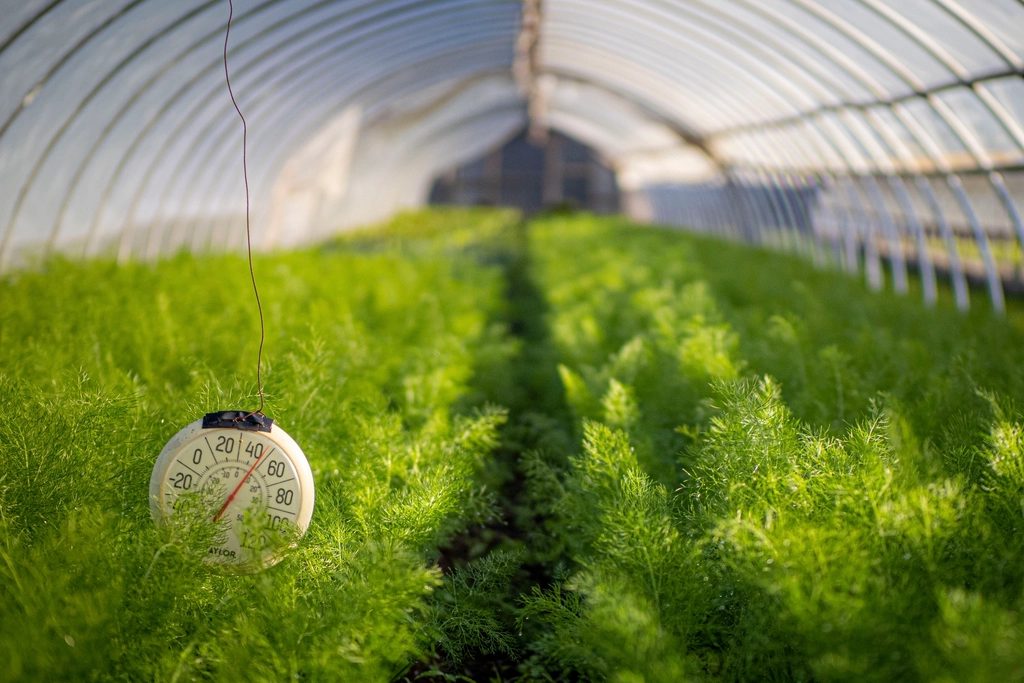
In Hwacheon, Gangwon Province, Jeong Bok-san's (58) greenhouses are busiest at dawn. At the hour when mist rises between the tomato stems, he makes a round of all eight greenhouses. In the old days, he'd reckon it in his head — "House 3 is due for side-shoot trimming, House 5 was sprayed a few days ago so it's fine…" But on this day a phone sat in his hand, and the screen showed a list titled "Crops to check today." A crop name, how many days in, and one yellow marker. He swiped across the screen once and said, "Today it's House 3, tomatoes."
Eight greenhouses, six crops (tomato, cucumber, zucchini, chili, lettuce, cherry tomato), 30 years of farming. Around this time of year, even with an extra hand or two it's easy to lose track of when each crop got which treatment. And yet he was alone, and calm. When asked his secret, he turned the phone around to show me. "This screen. I built it." The only thing he ever did on a computer, he said, was occasionally look up market prices.
Thirty notebooks in the shed, you said. How did you used to look at them?
I wrote in lined notebooks with a pencil. One a year. The day I transplanted the seedlings, the weather that day, the day I watered, the day I sprayed, the first-harvest day. Some years I added a short line — "transplanted too early this year," "the rainy season ran long and we got soft rot." About thirty of them. Each cover marked with a year — my whole farming life.
I hardly skipped a year. I was diligent. And yet, strangely, they were only half useful. That shows when you go to open them again. When I'd wonder "when did I transplant the tomatoes around this time two years ago?", I'd pull two-years-ago's notebook off the shelf and turn the pages one by one, wetting my finger. If I found it, good; if the pencil had faded, I'd carry it to the window and stare for a while. Some notes didn't say which house they were for, so I'd guess from what came before and after.
What frustrated me more was comparing. To know "did I transplant earlier this year than last?", you have to lay the two notebooks side by side and line up the dates. To look at five years, you've got no choice but to spread out five notebooks and let your eyes go back and forth. Thirty years of experience was clearly all there on that shelf, but I couldn't ask it anything. It was there, but I couldn't reach it.
So you built your own tool. A farmer — did you learn to develop?
No. That's the whole point. I can't write code. I hunt and peck at the keyboard. All I did was decide what was needed. What should appear on the screen, what fields there should be, what to look at first today — I know that because I've farmed for 30 years. Translating that into something a computer understands was always the wall, and that's the part makemind took over.
I didn't draw the screen — I described it. When I pick a crop, this year's records spill down. At the top, how many days since transplanting, big and clear. When something new happens, press a button to add one line, and the date fills in as today automatically. When I describe in words what to show and where, like that, it becomes the screen. I didn't do any design; I just said what I needed.
"I didn't draw the screen — I described it. Because out in the field, I know best what matters. I can't draw, but I can talk."
Can you show us what actually happens behind that screen?
Of course. The screen is really the very last step. There's a flow before it. A line of notes comes in, it piles up per crop in chronological order, today's items to check get surfaced, and it appears on screen. I didn't design that flow — I only decided what goes into and comes out of each stage.
First stage — how do the records get in?
While working in the field, I pull out my phone and press a button once. "House 3, tomato, side-shoots trimmed," like that. The date fills in as today on its own, and the day count tallies itself from the transplant day. I can do it with dirt on my hands, so I don't have to do what I used to — finish work, go to the shed, open the notebook, and write. One line, right there on the spot.
I'm also moving over the thirty aged notebooks bit by bit. No need to copy every single line — just the big ones first: transplant days, first harvests, notes like "this year something happened." Once those went in, 30 years started to connect within a single screen.
What matters is that which house, which crop's record it is gets attached along with it. That's the field I used to guess at because I hadn't written it down. Now it's always attached, so there's no more "which field was this from?" later on.
Next, where do the records accumulate?
For each crop there's a place where records pile up in chronological order. "Transplanted March 12," "first watering April 1," "sprayed May 3," "first flower May 20" — one after another, in a row. And every line carries which house it came from.
This is the crucial difference from paper. Paper stops at writing it down. Pulling out what was written and lining it up is left to human memory and patience. But once the same fields go into fixed places, from then on it becomes something you can ask questions of. "Gather just the watering days this year." "Last year's and this year's transplant days side by side." What would take days on paper takes one press. Because this year's line and last year's line are the same shape, the machine can line the two up for me.
This is where a little magic begins. What used to just get written down starts to multiply the moment it lines up in the same shape. When I overlay last year's records on this year's, I see things I — looking at only one year — couldn't see. Thirty years on paper never showed me that. Because every notebook was different — some years I wrote only dates, some had long notes, some didn't mark the house. The shapes were all over the place, so they couldn't be overlaid. Once I moved them into the same fields, they could finally overlap, and once they overlapped, the patterns surfaced.
So how does "Crops to check today" appear?
Every dawn it runs through the six crops once. How many days since transplanting, how many days since watering, what was I doing around this time last year. It scans by these criteria I set and surfaces what needs my hands today.
It doesn't just count dates. Yesterday the screen showed "House 3 tomato — 18 days since transplant, first flower around this time last year." It doesn't just tell me how many days in; it attaches what there was at the same point last year right beside it. What would've taken me a while with two notebooks laid out, it points out first, so I just go and check.
This is the screen I look at every dawn. At the top, crops that need my hands today, each with its "days-in" chip; below, one line for what to handle this week. See that card at the bottom? "Tomato — 18 days since transplant, first flower last year on days 18–20." That, too, isn't something I counted by hand — it surfaced it on its own. Once five years had piled up, that kind of thing showed itself. That the first flower always opened around 18 days after transplanting — what I couldn't find in 30 years on paper, surfaced on its own in five years once it piled up in the same shape. I'd always known it by feel, but feel and seeing it with your eyes turned out to be different things.
To sum up — what did you, Mr. Jeong, do, and what did makemind do?
What I did was the judgment. What fields there should be, what to look at first, which notes will be useful later, which point last year to compare against. Only someone who's farmed for 30 years knows that. Which fields absolutely have to be there and which ones can be skipped — that's not in any datasheet, not in any pesticide manual. It's only inside my 30 years. What makemind did was carry that judgment.
| Stage | What I decided (30 years of judgment) | What the tool did |
|---|---|---|
| Record input | What fields to have (house, crop, task, note) | One line per button-press out in the field, date and day count automatic |
| History building | What to keep as a record | Stored per crop in chronological order, with sources |
| Today's check | What to use as the criteria | Scanned the six crops to surface the crops needing hands and last-year comparisons |
| Discovery | What patterns to suspect | Let patterns surface from same-shaped data |
| Screen | What to show, where | Rendered it to screen exactly as described |
I only filled in the left column. The tool took the right side. Work that would have taken months to learn to develop, or a few rounds of feeling sorry for asking someone — I did it just by putting my judgment into words.
So does this do the farming for you?
No. I want to be clear about that. This screen doesn't grow the tomatoes. I have to trim the side-shoots myself, and in the end I decide the watering by feeling the soil myself. "18 days in means first flower" — that's a tendency, not an order. If spring was cold this year, it might flower on day 22, and going into the greenhouse that day to look at the stems and the leaves and judge is still my job. Even if the screen says "check House 3 today," if I go and it's not ready yet, I don't trim. The screen doesn't know that.
What the machine does goes only as far as suspecting first for me. The real judgment after that, a person makes. Even after 30 years, farming has something new every year, so a tool can't replace that. It just backs me up so I don't forget, so I don't miss things. The hands get lighter, the head gets freer, and I get to focus more on the judgment that really matters. That's exactly where this screen's job ends. And that's just right.
What changed the most?
My head got freer. I used to always have a feeling of forgetting something. "How many days since I watered House 5," "isn't it past time to spray the chilies" — those were always floating around in my head. With six crops and eight houses, trying to memorize it all left my head packed full. Now, one look at the screen at dawn and everything urgent for today comes up. The screen does the memorizing; I just look at the soil.
And 30 years doesn't scatter. As long as the notebooks lie asleep in the shed, they're just a pile of faded handwriting. When I'm gone, the next person can't salvage even a quarter of what I knew from there. But once I've moved it into the same shape, this becomes something the next year can ask questions of. My son comes out to the field now and then; someday, when he takes this over — just as I found the 18-day pattern, he'll read out of it even what I couldn't find.
"It used to be that six crops across eight houses were always floating around in my head. Now, one look at the screen at dawn is enough. With my head freer, I find I can focus more on actually looking at the soil."
Any advice for other farmers?
Don't start big. I didn't build all of this from the start either. I started with a single screen — "pick a crop and this year's records appear." Once that worked, I added adding a line by button, then counting the days, then the last-year comparison — one column at a time. On a weekend afternoon, no pressure.
Here's the key. What you know best is your field, not the computer. You just have to describe what you know so well. Whether it's a dues ledger, a shipping record, or the attendance sheet for the village crop group — there are things too small to make it to market, too much your own way for someone else's product to fit. The things you've just been putting up with all this time. You can't draw, but you can talk. A screen built by a hunt-and-peck typist like me is holding up my eight greenhouses right now.
makemind.dev "Field" — the person who knows the domain best, building their own tool with their own hands. Jeong Bok-san's growing log was built not from code but from 30 years of judgment.